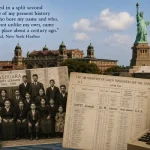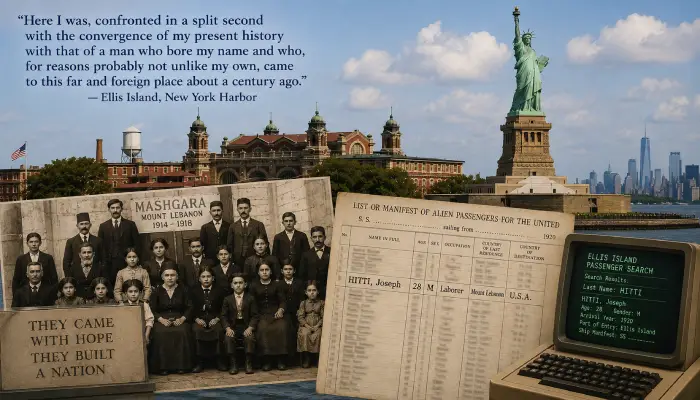
This past summer I took the Boston-New York train with my daughter Sarah on a trip to Ellis Island, that small outpost in New York City harbor. For all the years that I have been in the US, I never visited New York City’s major attractions. I also wanted Sarah, who was born in the US, to see New York City, the Statue of Liberty, Ellis Island, and also the huge pit where the World Trade Center towers once stood. To tiny Ellis Island, whose low-lying buildings seem dwarfed by the soaring arms of the Statue of Liberty nearby, huge transatlantic ships brought millions and millions of immigrants from the Mediterranean world to the United States at the turn of the 20th century.
Among the many immigrant artifacts, documents and photos, displayed at Ellis Island, there is a huge mural photograph depicting an extended family from the village of Mashghara in Lebanon, one testimonial I thought to myself to those early immigrants from Lebanon who built this country side by side with people from other countries. The Mashghara family had come to America some time around 1914-1918 and settled in the town of Methuen, north of Boston, Massachusetts, to work in the textile mills of New England. Visitors to Ellis Island can even query a computer terminal about their ancestors and family members who may have entered America through this gate. Though I knew of no one from my immediate family who had come here – most of them had gone to Latin America – I typed my last name and waited. To my pleasant surprise, the computer spit out the name of one Joseph Hitti, immigrant from Mount Lebanon, as a passenger on the manifest of one of the ships who had made his way through Ellis Island circa 1920. So here I was, confronted in a split second with the convergence of my present history with that of a man who bore my name and who, for reasons probably not unlike my own, came to this far and foreign place about a century ago.
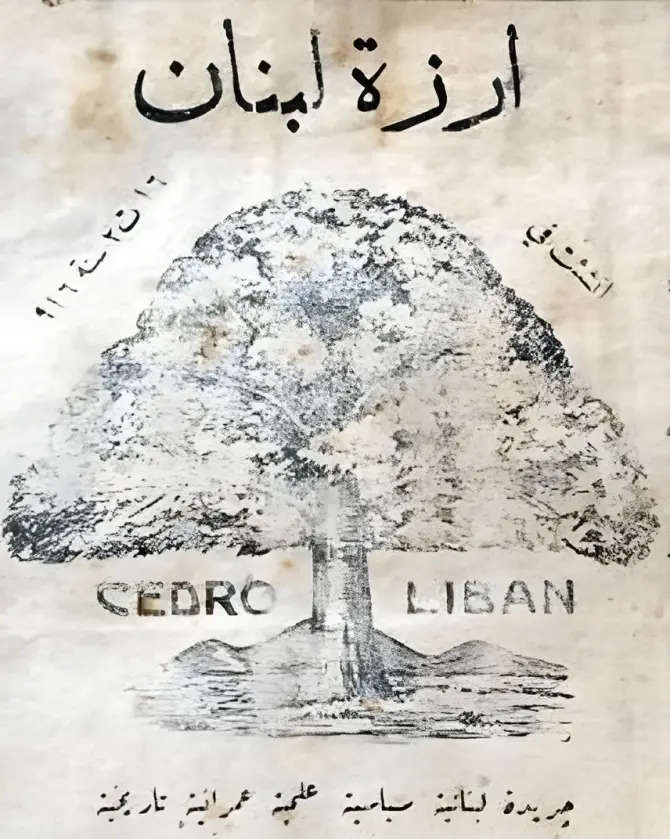
As World War I was afoot in the early 1910s, the Ottoman Turkish government in Istanbul abrogated the autonomous status (Al-Mutassarifiyyah or Self-ruling Governorate) of Lebanon that had been in effect since 1861, and the Turkish army re-occupied Lebanon and imposed martial law and forced conscription. It confiscated food, animals, and every available resource. It executed by hanging in downtown Beirut every free patriot – Moslem and Christian alike – who called for an end to the occupation and the independence of the country. And as if the Turks were not enough, the locust descended on Lebanon in 1916 and finished off every tree, garden and field. Growing up in Beirut, I heard stories from those years. Stories of hungry people walking behind mounted Turkish soldiers to pick up grains to eat from the droppings of the soldiers’ mules and horses. Stories of cannibalism. Stories of entire villages that disappeared from existence because everyone in the village packed up and left for America. To this day, one can see clusters of crumbling stone houses that once constituted villages or hamlets still dotting the landscape of the Lebanese hills. These remnants of once prosperous and ancient villages stand still from the moment the last family member walked out the door to never return to the land.
The question in my mind is whether for all these immigrants the reason to leave their homes is more to escape a particular reality than to reach out for something new. Is it because he just can’t bear the difficult present any longer that one packs and leaves? Or is it because he wants more out of life, even if the present is painful but bearable? I suspect the answer lies somewhere in between because to live as an immigrant is to live in between two worlds, never really settling the dilemma of belonging at once to two worlds. Immigrants like me always idealize the places they left behind. With the passage of time, they seem to erase from their memories all the negative images of war and hunger that may have pushed them to leave in the first place, and instead keep alive the positive images of beauty and longing for the old country that should have kept them there. I have heard it so many times from immigrants from all countries, of all ages, and no matter the years they have spent in this country, they all say they are going back one day, even as they find a job, marry, buy a house, settle down, and grow old. If you ask them on their deathbed, they’ll tell you: “I am going back”.
During the years leading up to and including World War I, what drove the Lebanese people to leave are pretty much the same conditions that push the young Lebanese people today into leaving: no jobs, no prospects, no hope in the future, despair, the humiliation of living under foreign occupation, and yes, hunger and want. When you deprive people of their basic material and spiritual needs, when they can’t vote with their hands, they vote with their feet. They just pack and leave.
As we all – resident Lebanese and the Diaspora – struggle to balance on one hand our desire to see people stay in Lebanon to reaffirm its identity and prevent its annihilation, and on the other hand our recognition that conditions in Lebanon are so poor that anyone in their right mind should leave, we need to remember that Lebanon has been there before many times in its history. We need to remember that no evil lasts forever and that one day our people will be free again. That even if those who leave are a loss to Lebanon, they also become Lebanon’s ambassadors in their new countries, creating strong and lasting cultural and economic ties that will serve Lebanon for many decades to come. In this global age of easy communications, leaving is no longer like leaving in the early 1900s when people never went back because the trip by sea was long and dangerous. Leaving today is only a few hours by plane. In this period of Lebanon’s history, more than at any time before, the past and the present are closer than we ever thought. Same wars, same troubles, same losses, but times have also changed, and it has become much easier to return. As I think of that Joseph Hitti who came to America in 1920 and who probably never went back, I think this Joseph Hitti who came here in 1982 for the same reasons will certainly go back.
We all have our war stories. Three stories I want to share with you are from World War I vintage, only to show that the people of Lebanon have previously been through difficult times in their history. Yet somehow, they always managed to recover and bring Lebanon back to life again.
On my mother’s side, my great-grandmother Yehudit, like many famished and desperate Lebanese during WWI, took the train from Beirut to Damascus searching for work and food. Syria apparently was spared Ottoman brutality and famine during WWI, and unlike Lebanon it had plenty of food and jobs, probably because it was ruled directly by an Ottoman Turkish Wali (governor) whereas Lebanon had achieved autonomy since 1861. With her on the train, Yehudit took two of her sons, and left behind her third son Youssef and her two daughters Adele and Rougina (who is my own grandmother). On the train, Yehudit fell sick with typhoid fever and woke up in Damascus to find that her two sons were not by her side. She was never to see them again. She returned mad to Lebanon, and I still remember her walking down the street of our Beirut neighborhood cursing the Turks, the Syrians, the Sultan, and sometimes even God himself.
My paternal great-grandmother Mariam also boarded the train to Damascus around the same time to see her son Khalil who, having been forcibly conscripted into the Turkish Army, was based in Damascus. On the trip back to Beirut, she either lost her ticket or did not have one, so the inspector kicked her off the train in Saoufar, high up in the Lebanese Mountains, and she had to walk from there all the way to Damour on the coast, where she died of exhaustion on her arrival.
Finally, here are excerpts from a letter written by a Lebanese father to his children who had left their parents to go to America. The letter is dated 1926, a good eight years after the end of World War I.
Zahle, August 2, 1926
Our dear children,
… In a previous letter you sent us twenty-five American riyals (dollars). We received them and we thank you from the bottom of our heart and express our unlimited gratitude. We ask the Almighty to grant us the opportunity to see you. May He keep you for us, our support and succor.
… We repeat our pleas to you not to stop writing to us because our thoughts are always with you.…As to the condition of our country, I think you know it better than we do thanks to the free newspapers of your country. Here it is a condition of agony and near death, whether from the standpoint of jobs or the outrageous high cost of living. People cry everywhere you go, and men can barely feed their families, especially those of modest means and the poor such as us. Emigration continues such that between now and the middle of winter there won’t be anybody left in Zahle because of hunger and lack of work…
(Name withheld)
Note: This piece is from the archives. It was first published on the Tayyar (Free Patriotic Movement) website on January 18, 2004.